Most businesses don’t fire their marketing agency because the agency was incompetent. They fire them because nobody asked the right questions before signing the contract.
We’ve had more discovery calls than we can count with business owners who left their last agency because of vague reporting, missed deadlines, or a strategy that never matched their actual goals. Choosing a digital marketing agency isn’t about finding the one with the flashiest case studies – it’s about finding the one whose process, pricing, and communication style actually fit how your business operates.
This guide walks through what to actually evaluate, the questions most people forget to ask, and the warning signs that show up before you’ve signed anything.
Start With What You’re Actually Trying to Fix
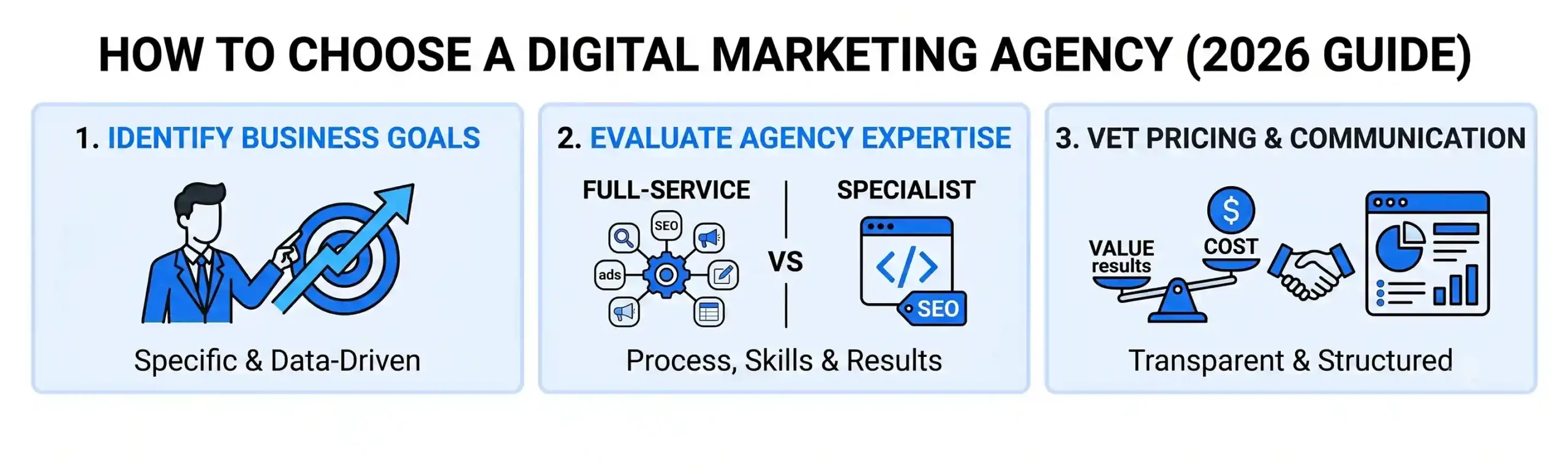
Before you look at a single agency, get specific about the problem. “We need more marketing” isn’t a brief – it’s a shrug. Are leads not converting? Is traffic flat? Is your brand invisible against competitors who spend less than you?
The reason this matters: agencies specialize, whether they admit it or not. A shop built around paid ads will often push paid ads as the answer to a branding problem. A firm that lives in SEO will stretch a six-month content plan onto a business that needed a faster fix.
Write down your actual goal in a sentence – “increase qualified leads from our website by [X%] in six months” is a brief. “Grow our business” is not. You’ll use this sentence to test every agency you talk to.
Full-Service vs. Specialist: Pick Based on Complexity, Not Prestige
There’s a persistent idea that full-service agencies are somehow less focused than specialists. In our experience, that’s backwards for most small and mid-sized businesses.
If your marketing touches SEO, paid ads, your website, and your CRM – and for most businesses it does – hiring four specialists means four teams that don’t talk to each other, four invoices, and you playing project manager between them. A full-service agency (one team handling strategy, execution, and the tech underneath it) removes that coordination tax entirely.
Specialists make sense in a narrower case: you have an internal marketing team that needs one specific gap filled, like conversion rate optimization or paid social. If that’s you, hire a specialist. If you’re building marketing from scratch or your current approach is scattered across vendors, a full-service partner will move faster and cost less in wasted hours than stitching together freelancers.
Ask to See Actual Work, Not Just Results
Case studies are marketing. Ask any agency you’re seriously considering to walk you through one real project, live, on the call – not a slide with a client name and a big percentage.
Push for specifics:
- What was the starting point, and what tools or channels did they use?
- How long did it take to see movement, and what did that first 90 days actually look like?
- What didn’t work, and how did they adjust?
An agency that can talk through a real failure and what they changed is more trustworthy than one that only has wins. Every agency has had a campaign underperform. The ones worth hiring can explain what they learned from it without getting defensive.
A Quick Gut Check: Ask About Their Own Marketing
If a digital marketing agency can’t show you how they market themselves – their own SEO rankings, their own content, their own lead flow – be skeptical. It’s a reasonable proxy for whether they actually practice what they’re selling you.
Pricing Models: Understand What You’re Actually Buying
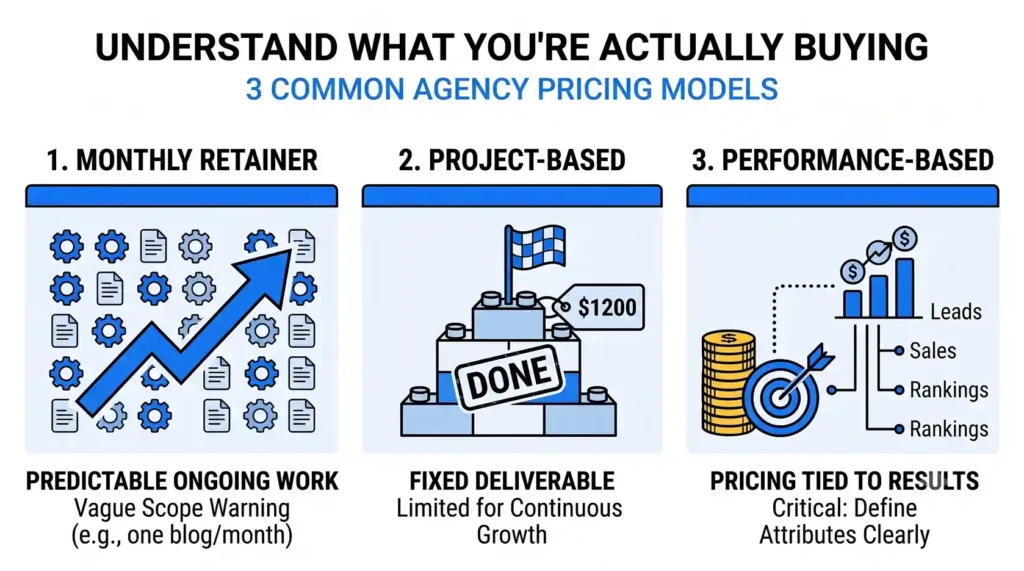
Agencies typically price one of three ways, and each comes with a trade-off:
- Monthly retainer – a fixed fee for ongoing work. Predictable, but ask exactly what’s included so “ongoing SEO” doesn’t quietly mean one blog post a month.
- Project-based – a fixed scope and price for a defined deliverable, like a website rebuild or a CRM integration. Good for one-off work, less useful for ongoing growth.
- Performance-based – pricing tied to results (leads, sales, ranking positions). Sounds appealing, but read the fine print on how “results” are defined and attributed, since agencies control that definition.
None of these is inherently better. The mistake is not asking which model you’re being quoted and matching it to what you actually need. A retainer for a business that needs one project done is overpaying. Performance pricing for a business that needs brand-building, which takes months to show measurable results, sets everyone up to be frustrated.
Communication and Reporting: Set the Standard Before You Sign
The single biggest driver of agency breakups isn’t results – it’s silence. Ask before signing:
- How often will we talk, and in what format (call, dashboard, email)?
- Who is our actual point of contact, and do they work on the account or just manage it?
- What does a monthly report look like? Ask to see a real, anonymized example.
If an agency can’t produce a sample report on the spot, that’s a preview of what working with them will feel like. You want numbers tied to your actual goal from Step 1 – not vanity metrics like “impressions” dressed up as wins.
Red Flags Worth Walking Away From
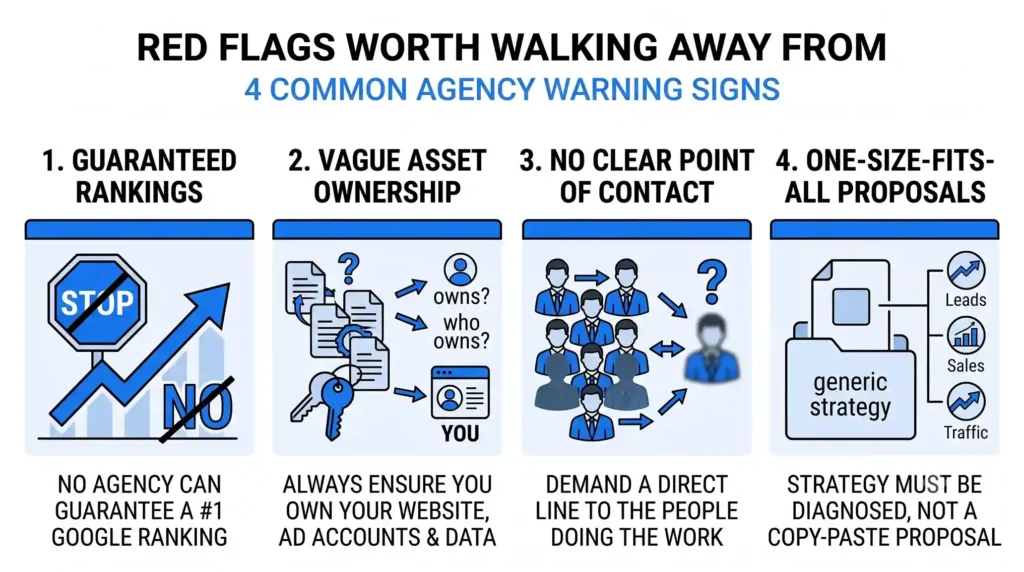
A few patterns show up again and again with agencies that don’t work out:
- Guaranteed rankings or results. No legitimate agency can guarantee a #1 Google ranking – search algorithms don’t work that way, and anyone promising it is either inexperienced or lying.
- Vague ownership of your assets. Ask upfront who owns your website, ad accounts, and analytics data if you leave. It should always be you.
- No clear point of contact. If you can’t get a straight answer about who’s actually doing the work, expect that confusion to continue after you sign.
- One-size-fits-all proposals. If the strategy they pitch you looks identical to what they’d pitch a completely different business, they haven’t actually diagnosed your problem.
The Bottom Line
The right digital marketing agency isn’t the one with the biggest client logos on their homepage – it’s the one that can clearly explain your problem back to you, show real work instead of highlight reels, and commit to reporting you’ll actually understand.
If you’re evaluating agencies right now and want a second opinion on a proposal you’ve already received – or just want to talk through what your business actually needs – book a free consult with our team. We’ll tell you honestly whether we’re the right fit, even if that means pointing you elsewhere.
Need a Second Opinion on Your Agency Pitch?
Get an honest proposal review or strategy chat. No pressure, no pitch.
Book Free Consultation →Frequently Asked Questions (FAQ)
How long should I commit to before switching agencies?
Most meaningful marketing results, especially SEO and organic growth, take three to six months to show clearly. Anything shorter and you’re judging noise, not signal. That said, you should see clear communication and a documented strategy within the first 30 days, even if results are still building.
Should I hire a local agency or is remote fine?
For most digital marketing work, location matters far less than it used to – strategy, execution, and reporting all happen remotely regardless of where the team sits. Local matters more if your business depends on local SEO or in-person collaboration, in which case ask how the agency handles local market knowledge specifically.
What’s the difference between an agency and a freelancer?
A freelancer is one person managing your marketing, which is often cheaper but leaves you exposed if they’re sick, overbooked, or move on. An agency gives you a team with backup coverage, broader skill sets, and continuity if one person leaves the account.
Can one agency handle SEO, ads, and my website?
Yes – that’s the core case for a full-service agency over hiring separate vendors for each channel. The advantage is a single team working from one strategy instead of three disconnected ones reporting different numbers.